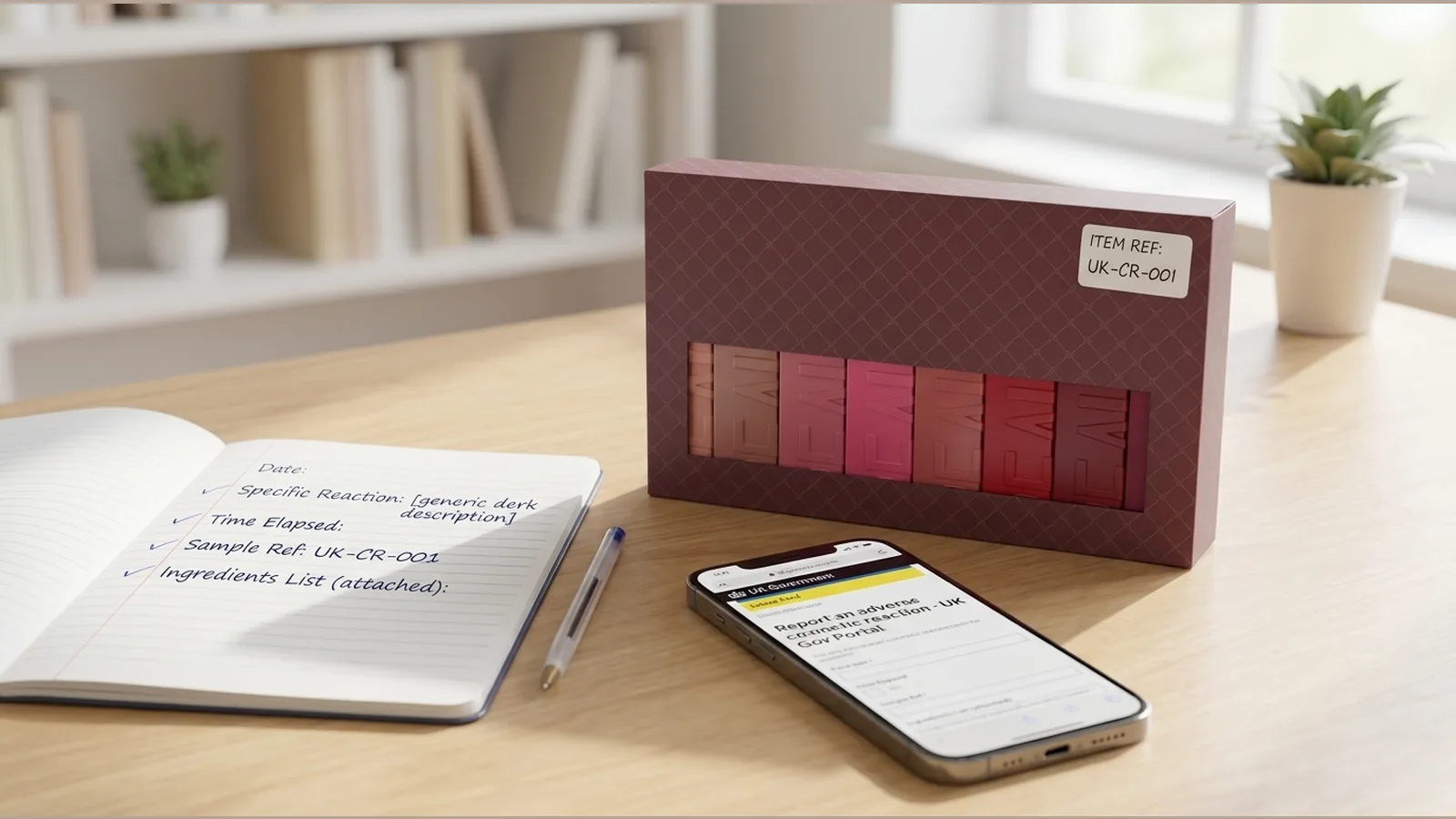
How to report a cosmetic reaction UK
If you need to know how to report a cosmetic reaction UK, stop using the product, keep the remaining item and packaging, write down what happened and any batch or labelling details you can see, then contact the seller or the UK Responsible Person named on the label and seek clinical advice when symptoms are worrying or persist.
Seek urgent help when needed
Seek emergency medical help straight away if you have severe swelling of the face, lips or tongue, difficulty breathing, widespread rash with feeling unwell, or any other sudden, serious symptoms after using a cosmetic. This article only signposts next steps; it does not replace clinical care.
Stop use and keep the product
Stop applying the product as soon as you suspect a reaction. Keep the leftover product, its outer pack and any leaflets. Do not wash off batch codes or discard packaging until you have recorded the details and, if needed, spoken to a healthcare professional or the Responsible Person.
For an eight-piece matte liquid lipstick set such as the DUNUF set with tubes labelled #01 to #08 (each tube marked 6 g; arithmetic total 48 g as 8 × 6 g), note which shade number you used and keep that tube with the rest of the set where practical.
Record product and batch details
Write a clear note while events are fresh. Useful points include:
- Product name and brand as shown on the pack
- Shade or tube number (for example #01 to #08 if that is what appears on the pack)
- Nominal quantity if stated (for example 6 g per tube)
- Batch number, durability or date marks if present on the label
- Where and when you bought it, and when you first used it
- When symptoms started, what they were, and whether you stopped use
- Photos of the labelling and of the affected area, if that is appropriate for you
Great Britain cosmetic rules expect specified labelling information such as ingredients, quantity, durability and batch number where applicable; if a detail is missing from the pack, record that gap rather than guessing from marketing images. Official guidance on making cosmetic products available in Great Britain and on Responsible Person duties, safety documentation, notification and Article 19 labelling is published by the UK government.
Contact seller or Responsible Person
Contact the seller and, where a UK-established Responsible Person is named on the label, that Responsible Person as well. Explain what happened, share your notes and ask how they want you to return or retain the product. GB cosmetics placed on the market need a UK-established Responsible Person, safety documentation, notification and the labelling information set out in the applicable rules; contacting the named person is the practical route for a product-specific report.
If the pack does not name a Responsible Person or you cannot find safety or notification details, still keep your records and raise the issue with the seller. Do not assume a listing is GB-compliant from marketing copy alone.
Serious undesirable effect reporting
A serious undesirable effect is an adverse reaction that is serious in nature. If you believe your reaction may fall into that category, tell the Responsible Person (when identified) and your healthcare professional promptly, and keep copies of what you send. Your notes on product identity, batch marks, timing and symptoms support that report. Secondary search phrases people use for the same task include report serious undesirable cosmetic effect, lipstick reaction UK reporting and cosmetic adverse reaction records—the same evidence pack helps in each case.
Clinical assessment and patch testing
Suspected skin reactions should be assessed by an appropriate healthcare professional. Contact dermatitis may be irritant or allergic; diagnosis and patch testing are clinical matters, not something a home product claim can settle. Follow medical advice on investigation and treatment rather than trying to self-diagnose from ingredient guesses or shade photos.
No re-challenge advice
Do not reapply the same product to “test” whether it caused the reaction. Re-challenge can worsen symptoms and confuse the clinical picture. Leave any further exposure decisions to a qualified clinician.
FAQ
What should I keep after a lipstick reaction?
Keep the tube you used, the remaining set if it helps identify the shade number, and all packaging that shows name, quantity, batch or durability marks. For the DUNUF eight-piece set, recording the #01–#08 mark on the relevant tube is more useful than inventing a colour name from a screen image.
Can I rely on website claims instead of the label?
No. Use what is printed on the product and pack. Incomplete online pages, licence numbers or brand statements do not replace a full ingredients list, Responsible Person details or other GB labelling and documentation requirements.
Does this site offer a warranty if I stop using a product after a reaction?
Warranty start points, exclusions, returns process and related terms are not fully specified here, so ask customer support for the current process when you report a problem.
Where can I review this lipstick set’s product page?
If you need the listing for shade numbers or pack identity while preparing your notes, see the current product details for the DUNUF 8-piece matte liquid lipstick set.
If you are documenting a reaction linked to this set, open the DUNUF 8-piece matte liquid lipstick set product details to match shade numbers and pack information against what you have kept, then follow the recording and reporting steps above.