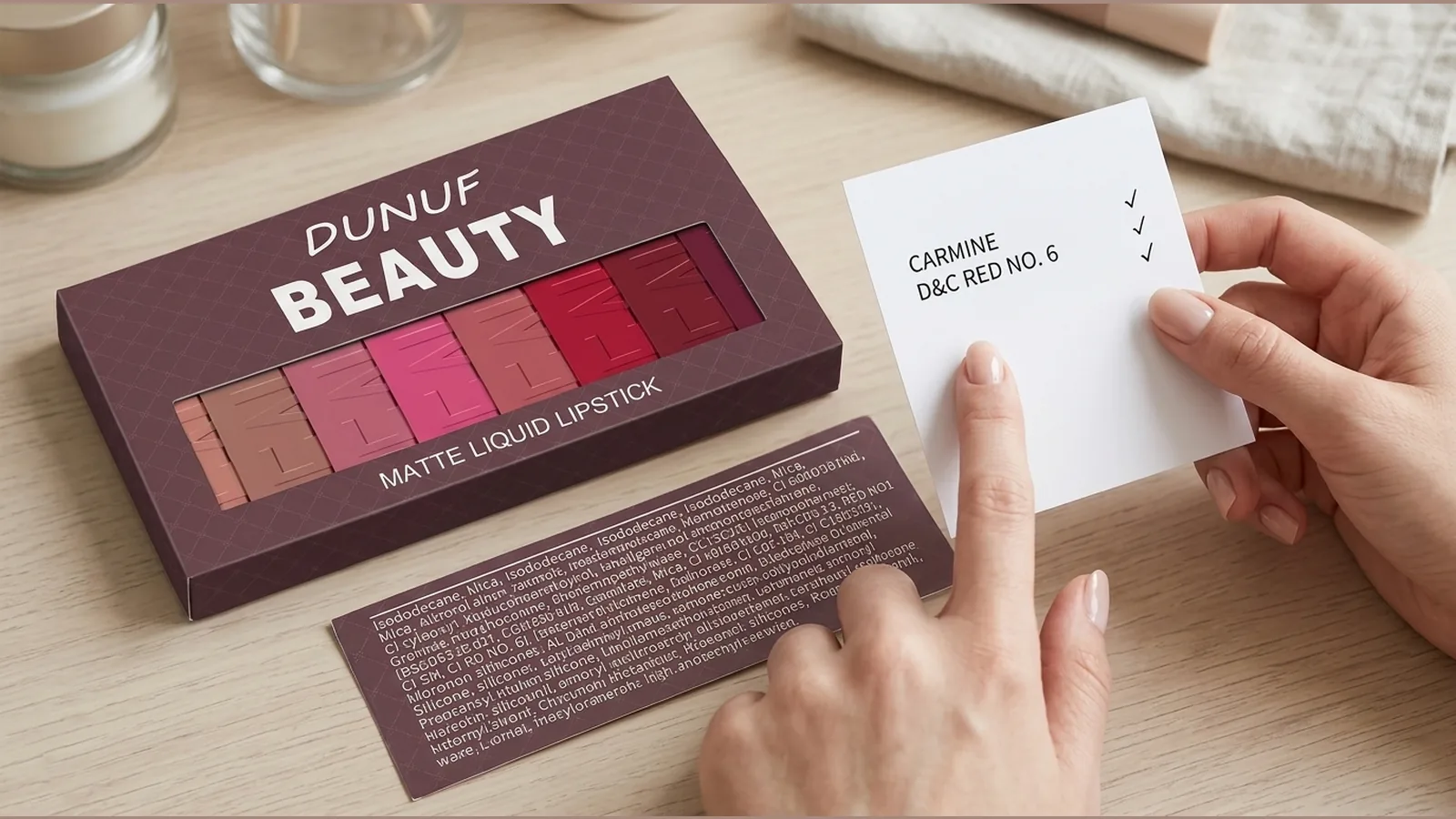
Lipstick ingredients list allergy check
Direct answer
A lipstick ingredients list allergy check means matching a clinician-diagnosed allergen name against the full INCI ingredient list and other required labelling on the pack you receive—not against marketing images, shade numbers or unverified product claims. If the list, Responsible Person details, batch identification or durability information is missing or unclear, do not assume the product is suitable; pause use and seek appropriate clinical advice if you react.
Use a diagnosed allergen name
Start with the exact allergen name given by a healthcare professional, not a vague suspicion such as “something in lipstick”. Contact dermatitis may be irritant or allergic, and naming the trigger is a clinical matter rather than a home product claim.
Write the name down before you shop or open a new set, then search the ingredients list for that term and closely related listed forms. Do not treat shade codes such as #01 to #08 as allergen information.
Find the ingredient list
On cosmetics sold to consumers, packaging should display key information including ingredients, precautions, quantity, Responsible Person details, batch identification and durability. For products made available in Great Britain, labelling and related duties sit alongside requirements for a UK-established Responsible Person, safety documentation and notification.
- Look for the ingredients list on the outer pack or each unit, usually headed with INCI names.
- Confirm quantity information (for a multi-piece set, that may appear per tube).
- Check that Responsible Person and batch identification details are present and readable.
- If any of these are absent on arrival, treat the allergy check as incomplete.
For the DUNUF eight-piece matte liquid lipstick set, publicly confirmed pack facts are limited to eight tubes labelled #01 to #08, each labelled 6 g (a controlled total of 48 g expressed as 8 × 6 g). A complete INCI list, UK Responsible Person details, SCPN notification, CPSR or PIF evidence are not available from the supplied product record, so you must rely on the physical label you receive rather than assuming those details online.
Keep packaging and batch details
Retain the box, inserts and each tube until you have finished checking. Batch identification and durability statements help you and a clinician relate any later reaction to a specific unit.
- Photograph the ingredients panel and batch mark before disposal.
- Keep quantity and Responsible Person text with the same photos.
- Use confirmed details PAO, shelf-life or batch data from marketing images if the pack does not state them.
Avoid home diagnosis
Matching a known allergen on a label is a labelling check, not a diagnosis. Irritant and allergic contact dermatitis need clinical assessment; patch testing is not something a product page can replace.
Do not conclude that a lipstick is “safe for allergies”, hypoallergenic or otherwise special from colour swatches, set size or unfinished online documentation. Avoid inferring ingredients from packaging artwork.
When to seek clinical advice
Stop using the product and seek appropriate healthcare advice if you develop persistent lip, mouth-corner or surrounding-skin redness, swelling, blistering, cracking or itching after application. Take your retained ingredients list and batch details to the appointment when possible.
Urgent care is warranted for severe swelling, breathing difficulty or other acute systemic symptoms—those are medical emergencies, not labelling questions.
Product-label verification CTA
Before you buy or open a set, plan to verify the physical ingredients list against your diagnosed allergen name on arrival. Review the current DUNUF eight-piece matte liquid lipstick set details for the confirmed unit count and labelled net quantity baseline, then complete your lipstick ingredients list allergy check only from the pack you receive. Purchases through this site are covered by a 12-month warranty; warranty start point, exclusions and claim steps are separate from cosmetic labelling checks.
FAQ
Is an online shade list enough for a lipstick ingredients list allergy check?
No. Shade numbers such as #01 to #08 identify units in a set; they are not an INCI ingredients list and cannot confirm the absence of a diagnosed allergen.
What if the product page has no full ingredient list?
Treat the online record as incomplete for allergy screening. Check the physical pack for ingredients, quantity, Responsible Person, batch identification and durability information required on consumer cosmetic packaging.
Can I patch-test lipstick at home instead?
Home experiments are not a substitute for clinical diagnosis or patch testing arranged by an appropriate healthcare professional.
Does a production licence number on a listing prove GB cosmetic compliance?
No. Great Britain supply involves a UK-established Responsible Person, safety documentation, notification and specified labelling. A licence number or marketing claim does not replace those checks on the pack you hold.