lipstick PAO symbol explained UK
Direct definition
The lipstick PAO symbol explained UK is the open-jar mark on cosmetic packaging that indicates the period after opening: how long the maker intends the product to be used once the seal is broken, usually shown as a number of months (for example 6M or 12M) beside or inside a small jar icon. It is a durability cue for opened cosmetics, not a guarantee of shade names, ingredients, transfer resistance or Great Britain market compliance.
On lipstick and liquid lipstick, that figure relates to the opened product’s intended use window when the packaging carries the mark. It does not replace a batch code, a full ingredient list or proof that a product has a UK-established Responsible Person, safety documentation or notification.
PAO versus minimum durability
UK cosmetics labelling guidance expects durability information among other particulars. Two related ideas are easy to mix up:
- Period after opening (PAO) — the open-jar symbol with a month count, used when the product’s durability after opening is the relevant message for the consumer.
- Minimum durability / “best before” — a date-based durability indication where that format is required or used instead of, or alongside, other durability information.
Official guidance on making cosmetic products available to consumers in Great Britain explains that products need a UK-established Responsible Person, safety documentation, notification and specified labelling information, which can include durability particulars. Consumer products cosmetics guidance also lists durability among the key information that packaging should display, together with precautions, quantity, Responsible Person details, batch identification and ingredients.
Neither PAO nor a best-before date proves hypoallergenic, vegan, cruelty-free or long-wearing claims. Those are separate assertions and should not be inferred from the jar icon alone.
Where the symbol may appear
The open-jar mark is typically printed on the outer carton, a leaflet or the container itself when that durability format is used. On multi-piece lipstick sets, look on the outer pack first, then on individual tubes if they are marked separately.
Absence of a visible PAO on a promotional photograph does not mean a product has no durability rule in real packaging, and a symbol in a stock or marketing image is not reliable evidence for a specific SKU. Do not infer PAO, shelf life or batch data from colour swatches or lifestyle shots.
Opening-date record
PAO only helps if you know when the product was first opened. A simple habit is enough:
- On first use, write the opening date on the carton or a note kept with the set.
- Add the PAO month count to that date to estimate the intended use-by window after opening.
- Keep tubes capped and stored as the label directs when storage advice is present.
If no opening date was recorded, treat any remaining PAO calculation as uncertain and rely on the packaging text you still have, plus common-sense checks for spoilage (see below).
Changes that need caution
Stop using a lipstick or liquid lipstick and seek appropriate healthcare advice if you suspect a reaction. Patch testing and medical concerns are clinical matters; this article only signposts that route.
Also treat the product with caution if you notice unusual smell, texture separation that does not match normal settling, unexpected irritation or visible contamination. Those observations are practical safety cues, not laboratory results, and they do not confirm or deny regulatory compliance.
What to do if information is missing
If the pack does not show a clear PAO, best-before date, ingredients, Responsible Person, quantity, precautions or batch identification, use confirmed details those details from images or marketplace copy. Great Britain guidance on Regulation 1223/2009 and the Cosmetic Products Enforcement Regulations 2013 describes Responsible Person duties, safety assessment, notification and Article 19 labelling requirements including ingredients, quantity, durability and batch number.
For shoppers, missing particulars mean you should ask the seller for the on-pack information before relying on the product, especially for multi-shade sets sold online where photos may omit the small print.
Soft product-label check
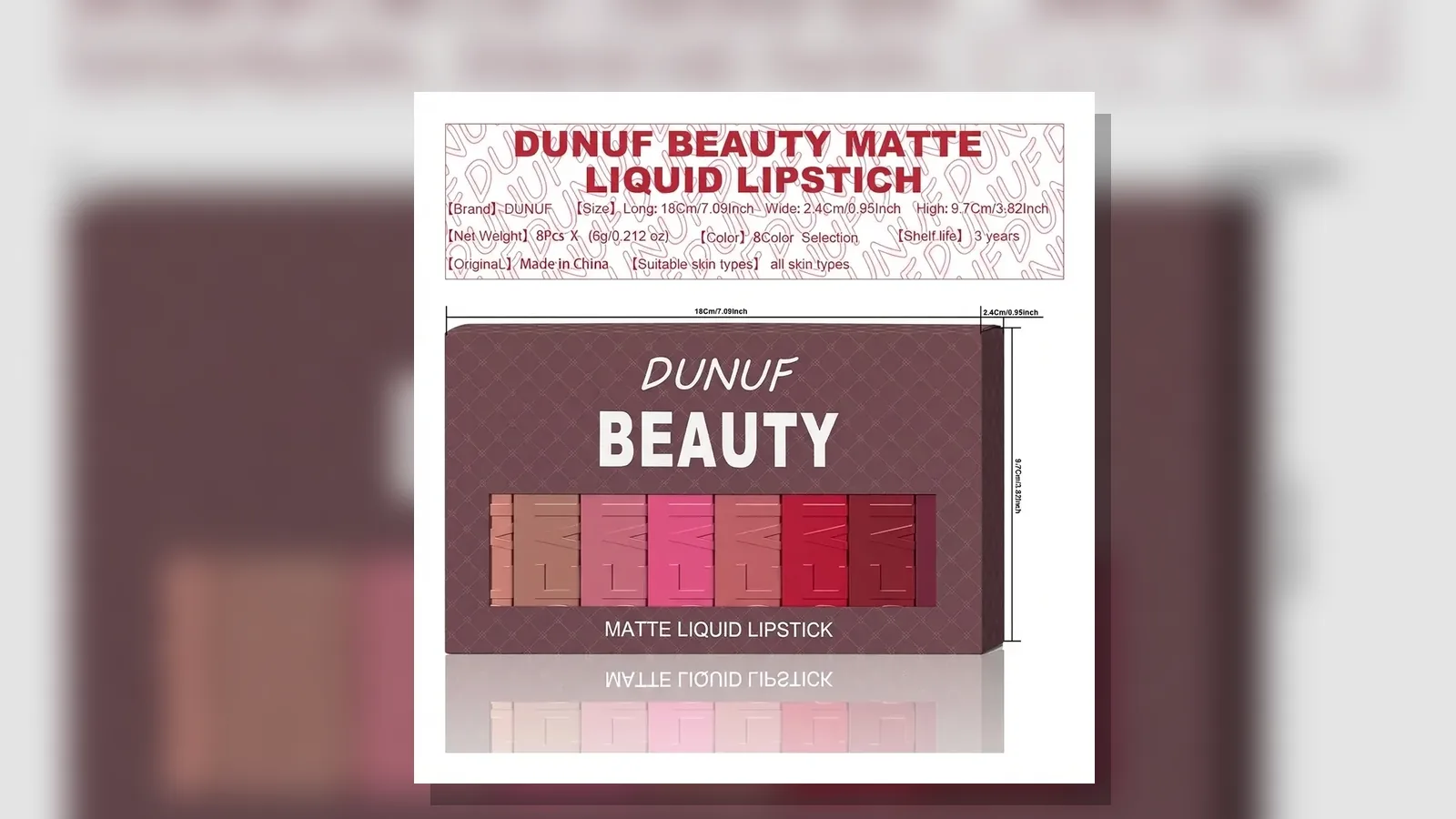
If you are reviewing a set such as the DUNUF eight-piece matte liquid lipstick set (eight tubes labelled #01 to #08; each tube labelled 6 g, so a controlled arithmetic total of 48 g expressed as 8 × 6 g), use the physical pack as the source of truth for PAO and other labelling.
- Confirm whether an open-jar symbol and month count appear on the outer pack or tubes.
- Note batch identification and any date-based durability text if present.
- Check for ingredients, quantity, precautions and Responsible Person details on the actual labelling.
Available product records for that set do not include a complete INCI list, UK Responsible Person, SCPN notification, CPSR or PIF evidence. Do not treat marketing claims, production-licence numbers or brand artwork as a substitute for Great Britain cosmetics labelling and documentation. Site sales of this range carry a 12-month warranty; warranty start, exclusions and claim process details are not expanded here where they remain unspecified.
For the current listing and pack photos, see the current product details.
FAQ
What does the open-jar symbol mean on lipstick?
It is the period-after-opening mark: the intended use period after the product is opened, shown as months with the jar icon when that format is used on the pack.
Is PAO the same as a best-before date?
No. PAO counts months after opening; minimum durability is typically a date-based indication. Packaging may use the format that fits the product’s durability rules.
Does a PAO symbol mean a lipstick is UK-compliant?
No. Compliance involves Responsible Person arrangements, safety documentation, notification and required labelling information. The jar icon alone does not prove those steps.
What if my lipstick set has no visible PAO?
Do not guess from photos. Check the physical label and ask the seller for durability and other mandatory particulars before use.